Medically reviewed by Dr. Alex Tam, D.C.
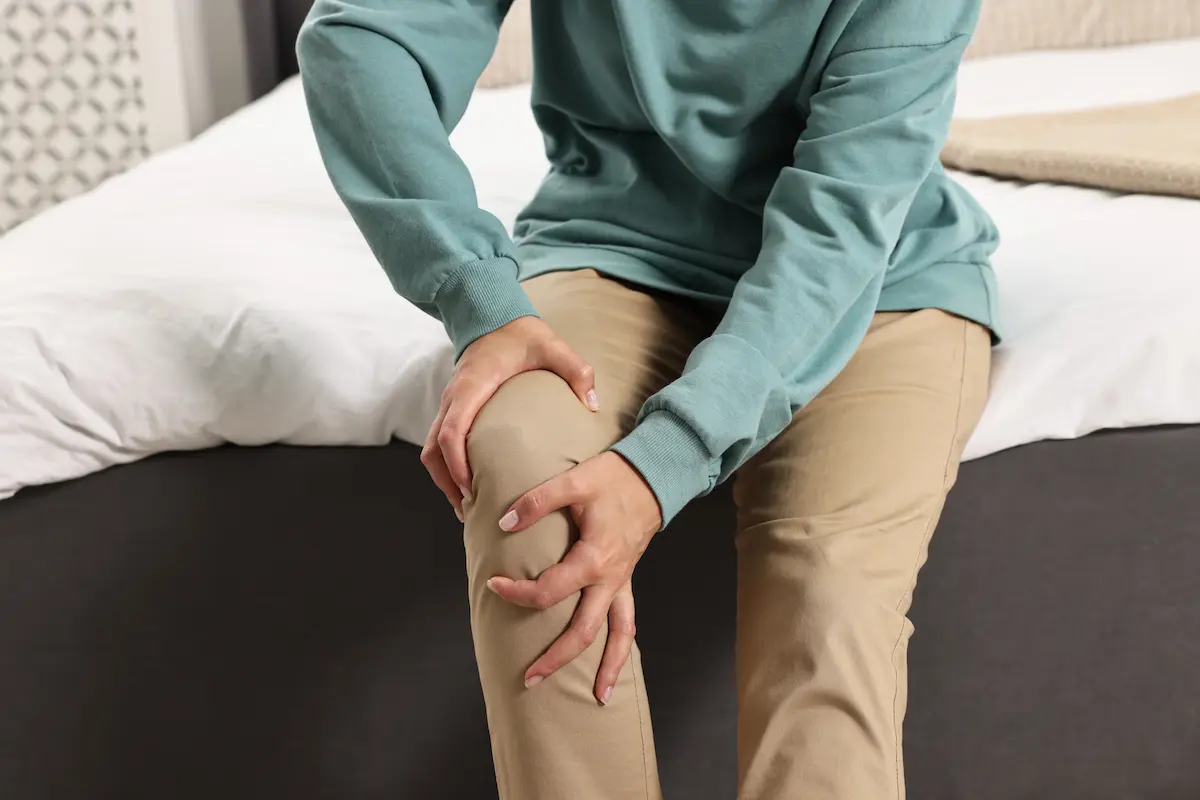
Knee stiffness after sitting for a long time often happens because the joint and surrounding tissues have gone through a stretch of inactivity, and conditions such as osteoarthritis can make that stiffness more noticeable. For many people, the knee feels stiff or hard to move during the first few steps after standing. It typically loosens within several minutes of walking or other gentle movement.
Why Does My Knee Feel Stiff When I First Stand Up After Sitting?
When a knee sits still for a while, the transition back to movement can temporarily make the joint feel stiff or difficult to move. This can be more noticeable in people with underlying knee problems such as osteoarthritis.
When the knee remains in one position for an extended period, the transition back to movement can temporarily make the joint feel stiff or difficult to move. The tissues around the joint can tighten slightly, and the sensation of stiffness often shows up the moment weight is placed back on the leg. This is sometimes called a first-few-steps problem. The knee may feel tight, achy, or restricted for a short stretch. It typically eases as walking continues. An occasional episode after a long flight or a movie is common and usually not concerning. Stiffness that shows up every time you sit, or that keeps getting more noticeable, deserves more attention than a one-off episode.
How Long Should Knee Stiffness Last After Sitting?
There is no single cutoff that applies to every knee, but stiffness lasting less than about 30 minutes is commonly seen with osteoarthritis. Duration alone cannot determine the cause.
The timing can offer a useful clue, though it is not a diagnostic test. Stiffness that fades within several minutes often points toward a temporary, inactivity-related pattern or a mechanical issue such as early osteoarthritis. The National Institute of Arthritis and Musculoskeletal and Skin Diseases (NIAMS) notes that osteoarthritis-related stiffness after rest is often brief, usually resolving in under 30 minutes.
Stiffness that lasts noticeably longer, happens more often, or extends over weeks or months follows a different pattern. So does stiffness with swelling or increasing pain. The table below compares how different knee conditions commonly behave after sitting, though every case can vary.
How Long Does Knee Stiffness After Sitting Usually Last?
| Possible Cause | What It May Feel Like | Typical Timeline | Response to Movement | Other Clues | When to Consider Evaluation |
|---|---|---|---|---|---|
| Temporary stiffness after inactivity | Tight, mildly uncomfortable | Usually short-lived | Often improves | No swelling or mechanical symptoms | If it becomes frequent or worse |
| Knee osteoarthritis | Stiff, achy, restricted | Often less than 30 minutes after rest | Improves with gentle movement | Pain, crepitus, reduced motion | Recurring or increasing limitations |
| Patellofemoral pain | Ache around or behind kneecap | After prolonged sitting or bending | May improve, but activity can aggravate | Worse with stairs or squatting | Persistent or activity-limiting symptoms |
| Acute knee injury | Pain plus stiffness | May persist and change during recovery | Depends on the injury | Swelling, bruising, instability | Prompt evaluation after significant injury |
| Meniscus-related problem | Stiffness with possible catching | Can recur with certain movements | May not fully resolve | Catching, locking, twisting pain | Locking or inability to fully extend |
| Inflammatory arthritis | More persistent stiffness | Often longer-lasting | May improve but can remain pronounced | Swelling, warmth, multiple joints | Evaluation is appropriate |
| Progressive knee problem | Increasing stiffness over time | Episodes more frequent or longer | Relief may become less complete | Increasing pain, swelling, weakness | Evaluation recommended |
This table describes common patterns, not guaranteed timelines or a diagnosis. Individual experiences vary, and duration alone cannot confirm a cause. Osteoarthritis stiffness duration reflects guidance from the National Institute of Arthritis and Musculoskeletal and Skin Diseases (NIAMS).
Why Does My Knee Get Better After I Start Walking?
Movement gradually restores range of motion and reactivates the muscles that support the knee, which is why symptoms often improve once walking resumes. Improvement with movement is a useful clue, but it does not identify the exact cause on its own.
As the knee moves through its range of motion again, supporting muscles reengage and the joint works through its available motion more freely. This can make the earlier tightness feel like it is fading. Mechanical stiffness related to inactivity or mild osteoarthritis often behaves this way, easing steadily as movement continues.
This response pattern is common enough that orthopedic symptom questionnaires specifically ask how a knee behaves after sitting or resting.
Could Knee Stiffness After Sitting Be Osteoarthritis?
Osteoarthritis is one possible explanation for knee stiffness after sitting, but it is not the only one. Stiffness after inactivity, pain with movement, and reduced range of motion are commonly reported together.
Osteoarthritis involves changes to cartilage and other tissues within the joint that can develop gradually over time. These changes can contribute to pain, stiffness, swelling, and reduced movement. The CDC reports that about 21.3% of U.S. adults had diagnosed arthritis in 2024, while about 33 million U.S. adults have osteoarthritis, making it the most common form of arthritis.
Common features include stiffness after rest, discomfort with movement, and a grinding or clicking sensation known as crepitus. Range of motion can also change gradually. One or two of these signs alone does not confirm arthritis, but a pattern that keeps repeating or slowly worsens tends to prompt a closer look.
What Other Conditions Can Cause Knee Stiffness After Sitting?
Osteoarthritis is common, but it is far from the only source of stiffness after sitting. Several other knee conditions produce a similar first-few-steps pattern for different underlying reasons.
Patellofemoral Pain
Patellofemoral pain often shows up after sitting with the knee bent for an extended period, sometimes called the movie-theater sign. It typically involves an ache around or behind the kneecap that worsens when standing, squatting, or climbing stairs. This pattern is covered in more depth in our guide to knee pain when going upstairs.
Meniscus Problems
A meniscus issue can also produce stiffness after sitting, often with catching or a sense that the knee will not fully straighten. Unlike typical mechanical stiffness, it may not fully resolve with movement and can recur with twisting motions. This mechanical pattern is also discussed in our article on knee pain going downstairs.
Tendon or Soft-Tissue Irritation
Tendon-related irritation behaves differently from joint arthritis. Symptoms are usually more localized and tender, and more closely tied to specific activities than to rest itself. Stiffness may ease with movement, but the tenderness pattern is typically more precise.
Inflammatory Arthritis
Inflammatory conditions can produce stiffness that behaves differently from ordinary mechanical stiffness. It often lasts longer, may involve visible swelling, and can affect more than one joint. Prolonged morning stiffness is a hallmark feature worth discussing with a provider.
Previous Knee Injury
A prior knee injury, even one that healed years earlier, can contribute to recurring stiffness after sitting. Old injuries sometimes lead to gradual degenerative changes or altered joint mechanics that make the knee more sensitive to periods of inactivity than it once was.
Does the Amount of Time My Knee Stays Stiff Matter?
Duration is a clue, not a diagnosis. Short-lived stiffness tends to fit a mechanical or inactivity-related pattern, while longer-lasting or increasing stiffness may point toward a different underlying issue.
Short-lived stiffness that clears within several minutes is often associated with mechanical patterns and everyday inactivity, and it can occur with osteoarthritis as well. Longer-lasting stiffness is more often associated with inflammatory conditions, and prolonged episodes may warrant a closer look. Stiffness that is gradually increasing over weeks or months is its own signal. This is especially true alongside swelling, rising pain, or a noticeable loss of function.
Why Is My Knee Stiff After Sitting but Fine Once I Walk?
If a knee feels stiff when you first stand but loosens after a few minutes of walking, the pattern can be associated with temporary stiffness after inactivity or with conditions such as knee osteoarthritis. Improvement with movement is useful information, but it does not identify the exact cause by itself.
This transition from stiff to comfortable is one of the most commonly described knee patterns, reflecting the shift from inactivity back into normal joint movement. Mechanical stiffness, early osteoarthritis, and patellofemoral symptoms can all produce it. Feeling fine after a few minutes of walking does not necessarily mean the knee is fully healthy. It simply means the stiffness responds to movement.
When Should I Be Concerned About Knee Stiffness After Sitting?
Brief knee stiffness after sitting can occur after prolonged inactivity and may improve once movement resumes. Certain signs suggest the knee should be evaluated sooner rather than later.
The signs below are considered red flags because they suggest something beyond routine inactivity-related stiffness.
Seek prompt medical attention for:
- Sudden, severe swelling
- Inability to bear weight on the knee
- Visible deformity around the joint
- Fever along with significant joint pain
Consider an evaluation for:
- Recurring stiffness
- Stiffness that is gradually lasting longer
- The knee locking or catching
- Recurrent swelling
- Declining mobility
- Stiffness following a significant injury
- Stiffness increasingly interfering with walking or daily activities
What Can I Do When My Knee Feels Stiff After Sitting?
Simple habits around movement and position changes can help reduce everyday stiffness while you track how your knee is behaving over time.
These general strategies are meant to support comfort and awareness, not to replace an individualized evaluation.
- Change position periodically rather than staying still for hours at a time
- Take brief movement breaks during long periods of sitting
- Gently move the knee through a comfortable range before standing fully
- Avoid forcing a stiff joint abruptly into deep bending
- Pay attention to any swelling or increasing pain
- Track how long the stiffness lasts each time it happens
- Note which activities make symptoms better or worse
What Does a Recurring Pattern of Knee Stiffness Tell Me?
Tracking your symptoms over time can reveal patterns that a single episode cannot. Duration, triggers, and accompanying symptoms are the most useful details to note.
A single stiff knee after a long car ride rarely means much on its own. A repeating pattern is more informative, and a simple record of each episode can make a later conversation with a provider more productive.
What to Track
| What to Track | Details to Note |
|---|---|
| Duration | How many minutes the stiffness lasts |
| Trigger | Desk work / driving / a movie / sleep / general inactivity |
| Location | Front / back / inside / outside / whole knee |
| Pain quality | Dull / sharp / aching / burning |
| Swelling | None, mild, or obvious |
| Response to movement | Better, worse, or unchanged |
| Mechanical symptoms | Clicking, catching, or locking |
| Frequency | Occasional, weekly, or daily |
| Functional impact | Walking / stairs / standing / getting out of a chair |
Is Knee Stiffness After Sitting Always Arthritis?
No. Knee stiffness after inactivity can occur for several reasons, and osteoarthritis is only one of them.
Several things can produce stiffness after sitting. Temporary inactivity, patellofemoral irritation, and a prior injury are all possible explanations. So are meniscus involvement and inflammatory conditions. Osteoarthritis is common, but symptoms alone cannot confirm a diagnosis. Stiffness rarely tells the whole story on its own. The broader pattern of joint pain and stiffness, tracked over time, is usually what helps clarify what is actually going on.
What Happens If Knee Stiffness Keeps Getting Worse?
Progressive stiffness, more frequent episodes, and declining mobility are signs that a knee condition may be advancing and worth evaluating sooner.
Progression tends to look like more frequent episodes, longer recovery after sitting, and increasing difficulty standing up comfortably. Pain may climb, walking tolerance may shrink, and swelling can become slower to resolve. New instability, a growing loss of range of motion, or symptoms spreading into daily activities are meaningful signals. None points to one diagnosis, but together they suggest it is time to stop adapting and have the knee looked at.
When Should I Have My Knee Stiffness Evaluated?
Consider an evaluation if symptoms keep returning, stiffness is lasting longer, or stairs and daily activities are becoming harder to manage.
A clear decision framework can help you decide when it is time to move from watching symptoms to getting them evaluated.
- Symptoms keep returning
- Stiffness is lasting longer than it used to
- Pain is increasing
- Swelling keeps recurring
- Mobility is gradually declining
- Stairs are becoming harder to manage
- You are avoiding normal activities because of the knee
- The knee catches, locks, or gives way
- Symptoms began after an injury
What Does Knee Stiffness After Sitting Mean for Long-Term Joint Health?
Recurring stiffness is worth understanding because it may reflect an underlying joint, mechanical, or inflammatory issue. It is not always simple, harmless inactivity.
An occasional stiff knee after a long flight is not typically a long-term concern. A pattern that keeps repeating, or that slowly changes over months, is more informative about what is happening inside the joint over time. Recurring knee stiffness can begin to affect walking, stairs, or everyday mobility. When that happens, a professional evaluation can help determine whether the pattern is consistent with arthritis or another knee condition. If it is part of a broader pattern of joint or musculoskeletal discomfort, pain management in Vacaville may provide another starting point for discussing conservative care options.
If recurring knee stiffness is affecting your mobility or daily activities, learning more about knee arthritis treatment in Vacaville can be a useful next step after discussing your symptoms with a qualified healthcare professional.
Knee Stiffness vs. Knee Pain: What's the Difference?
Knee stiffness and knee pain are related but not identical. Stiffness usually describes difficulty moving the joint or a tight/restricted sensation, while pain refers to an uncomfortable or painful sensation. A person can experience either symptom alone or both together. Understanding the difference can help you describe your symptoms more accurately to a healthcare provider.
Frequently Asked Questions
Conclusion: Understanding Knee Stiffness After Sitting
Knee stiffness after sitting is a common experience, and for many people, it is a temporary nuisance that resolves with a few steps. However, when the pattern becomes recurring, lasts longer, or is accompanied by other symptoms like swelling or pain, it is a signal to look deeper. The duration of stiffness, its response to movement, and any associated symptoms are all valuable clues, but they are not a diagnosis.
If your knee stiffness is affecting your daily life or you are concerned about what it might mean for your joint health, a professional evaluation can help determine the cause and guide appropriate next steps.
This content has been reviewed by our healthcare professionals for accuracy and educational purposes. It should not be used as a substitute for professional medical advice, diagnosis, or treatment.
References
CDC: Arthritis Data and Statistics
CDC: Osteoarthritis Statistics
NIAMS: Osteoarthritis
NIAMS: Rheumatoid Arthritis