Recognizing Herniated Disc Symptoms: Early Signs and Non-Surgical Care Options
A herniated disc does not always announce itself dramatically. For many patients in Vacaville, symptoms begin as mild back stiffness or occasional discomfort - easy to dismiss as normal soreness. But when a disc presses on a nearby nerve, the signals your body sends become harder to ignore.
Recognizing herniated disc symptoms early is one of the most important things you can do for your long-term spinal health. The earlier compression is addressed, the smaller the window for nerve damage to develop.
Table of Contents
- What Is a Herniated Disc and Why Does It Cause Symptoms?
- What Causes a Herniated Disc?
- Common Herniated Disc Symptoms to Watch For
- Why These Symptoms Should Not Be Ignored
- How a Herniated Disc Affects Daily Life
- When Should You Seek an Evaluation?
- Treatment Options for Herniated Disc Symptoms
- Herniated Disc Treatment in Vacaville
- Frequently Asked Questions About Herniated Disc Symptoms
What Is a Herniated Disc and Why Does It Cause Symptoms?
Your spine is built from vertebrae stacked on top of each other, separated by soft discs that absorb shock and allow you to move freely. Each disc has a firm outer layer and a gel-like center.
When the soft inner material pushes outward through the outer layer, that is a herniated disc. If the protruding disc material contacts a nearby nerve root, it creates pressure that triggers pain, numbness, tingling, or weakness - sometimes far from the spine itself.
This is why herniated disc symptoms are often felt in the legs or feet rather than only in the back.
What Causes a Herniated Disc?
Age-Related Disc Degeneration
Spinal discs gradually lose water content and flexibility as the body ages. This makes the outer layer more brittle and vulnerable to cracking or tearing under pressure. For many patients, no single event causes the disc to herniate. It is the accumulated effect of years of stress on a disc that has already weakened.
Repetitive Physical Strain
Jobs or activities that involve repeated bending, lifting, or twisting place ongoing stress on the spine. Over time, this wears down disc integrity even when individual movements seem manageable. Construction workers, drivers, and athletes are among those at higher risk for disc problems related to repetitive strain.
Sudden Injury or Improper Lifting
A sudden movement - especially lifting a heavy object with poor technique - can cause an already-stressed disc to shift or rupture quickly. Unlike degenerative herniation, this type tends to produce immediate, sharp symptoms.
Prolonged Poor Posture
Sitting or standing for long periods with a forward-leaning posture increases pressure on the front of the spinal discs. Over months and years, this can contribute to disc damage even in younger patients. Many people who work at desks experience early disc problems for exactly this reason.
Common Herniated Disc Symptoms to Watch For
Symptoms vary depending on where in the spine the herniation occurs and how much nerve compression is involved.
Lower Back Pain
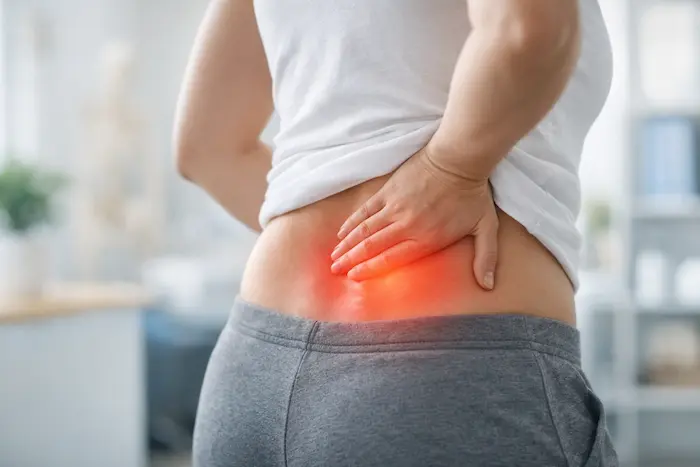
Pain localized to the lower back is often the first sign. It may feel dull and persistent, or sharp and stabbing - and it typically worsens with bending, lifting, or prolonged sitting. Some patients describe the pain as a deep ache that never fully goes away.
Radiating Pain Down the Leg
When a herniated disc compresses the sciatic nerve, pain travels from the lower back through the buttock and down one leg. This is sciatica - one of the most recognizable symptoms of lumbar disc herniation. The pain can range from a mild ache to a sharp, burning sensation that makes walking difficult.
Learn more about sciatica and how it relates to disc herniation →
Numbness and Tingling
Nerve compression disrupts normal signal transmission. This often produces tingling or numbness in the legs, feet, or toes on the affected side. Some patients describe it as a persistent "pins and needles" feeling or patches of skin that feel partially numb.
Muscle Weakness
When nerve compression is more significant, the muscles controlled by that nerve may begin to weaken. This can show up as difficulty gripping with the foot, stumbling, or a general feeling that the leg is unreliable. Weakness that develops alongside pain or numbness is a sign the nerve is under meaningful pressure.
Why These Symptoms Should Not Be Ignored
Herniated disc symptoms rarely stay static. Without intervention, ongoing compression tends to worsen - and nerves that have been compressed for extended periods are harder to rehabilitate.
Patients who delay evaluation often report:
- Pain that spreads further down the leg over time
- Numbness that expands from toes to the entire foot
- Weakness that affects walking and balance
- Disrupted sleep from pain that intensifies at night
The longer the nerve remains compressed, the more the window for full recovery narrows. Early assessment does not just help with symptoms - it protects long-term nerve function.
How a Herniated Disc Affects Daily Life
Pain and numbness in the lower back and legs affect nearly every aspect of daily movement. Patients frequently describe difficulty with:
- Sitting through a full workday without shifting constantly
- Getting up from a chair without a sharp pain spike
- Bending down to pick something up from the floor
- Walking longer distances without the leg becoming numb
- Finding a comfortable sleep position
These limitations compound over time. What begins as occasional discomfort can gradually shrink the range of activities a person feels able to do - affecting work performance, exercise habits, and quality of life.
When Should You Seek an Evaluation?
Not every episode of back pain requires an urgent appointment. But certain patterns are clear indicators that an evaluation is warranted, and early care is recommended as the symptoms become more recurring the problem may become irreversible.
Consider seeking care if:
- Back or leg pain has persisted for more than two to three weeks
- Symptoms are worsening rather than improving
- Numbness or tingling is spreading to new areas
- Weakness has developed in the leg or foot
- Pain is disrupting sleep or making it difficult to sit, stand, or walk
A thorough physical examination can often identify signs of nerve compression before imaging is even needed. Accurate diagnosis is what separates targeted treatment from guesswork.
Treatment Options for Herniated Disc Symptoms
Most herniated disc cases respond well to non-surgical approaches - particularly when treatment begins before damage becomes severe.
Spinal Decompression Therapy
Spinal decompression creates gentle traction forces that reduce pressure on compressed discs and nerve roots. This allows the disc to retract slightly and reduces the irritation on surrounding nerves.
Learn more about spinal decompression therapy and whether it may be appropriate for your symptoms →
Chiropractic Care
Spinal adjustments help restore proper alignment and reduce mechanical stress on affected discs. When the spine is better aligned, pressure on nerve roots decreases and mobility improves.
Explore chiropractic care options available in Vacaville →
Regenerative Medicine
Regenerative therapies support the body's healing response at the tissue level. By reducing inflammation and encouraging repair, these approaches address the underlying disc environment - not just the symptoms.
Review regenerative treatment options for disc-related conditions →
Movement and Rehabilitation
Targeted rehabilitation exercises strengthen the muscles that support the spine. Stronger supporting muscles reduce the load placed on spinal discs and help prevent future episodes. Rehabilitation is most effective when it follows a proper diagnosis and is designed around the specific level and nature of the disc problem.
Herniated Disc Treatment in Vacaville
Patients in Vacaville dealing with back pain, leg pain, or nerve symptoms deserve an evaluation that looks at the whole picture - not just the most obvious complaint.
Understanding exactly which disc is involved, which nerve is affected, and how far the condition has progressed allows treatment to be precise and effective. That comprehensive approach is what produces lasting results rather than temporary relief.
Frequently Asked Questions About Herniated Disc Symptoms
Early signs typically include localized lower back pain, stiffness with certain movements, and occasional discomfort that worsens after prolonged sitting. Some patients notice mild tingling in the leg before pain becomes significant.
Yes - the majority of herniated disc cases improve with non-surgical treatment. Approaches like spinal decompression, chiropractic care, and targeted rehabilitation have helped many patients avoid surgery entirely.
The pain is often described as sharp, burning, or deep and aching. When a nerve is involved, pain typically travels a predictable path - from the lower back through the buttock and down one leg.
Symptoms vary widely depending on the severity of the herniation and when treatment begins. Some patients see improvement within weeks. Others with more significant nerve involvement may take several months of consistent treatment.
Seek evaluation if pain persists beyond a few weeks, if numbness or weakness develops, or if symptoms are getting worse rather than better. Weakness in the leg or foot in particular warrants prompt attention.
Gentle movement is generally encouraged, but the type of exercise matters. High-impact activities and heavy lifting can worsen compression. A guided rehabilitation plan designed around your specific diagnosis is the safest approach.
We are ready to help you – Schedule an Appointment Today
If you have been suffering from back pain, leg pain, or signs of nerve compression that may be affecting your overall health and wellness, don't wait any longer. For personalized treatment options and expert guidance, schedule a consultation with our team of specialists today!
Visit: 👉 https://absoluteintegrativehealth.com
Or contact Absolute Integrative Physical Medicine to schedule a comprehensive evaluation for your spinal health and nervous system function today.
Schedule an appointmentGive us a call today at (707) 474-5688 and secure your spot this month for an in‑depth evaluation. Stop pushing and ignoring symptoms and pain – let us take care of you so you can get back to enjoying your life!