Mitochondrial health refers to how efficiently mitochondria produce energy inside your cells. Because every repair process requires energy, mitochondrial function plays an important role in recovery, tissue repair, and overall cellular performance. Why do some people recover quickly while others struggle for months? The answer may lie within your cells. The process of mitochondrial support is central to how your body repairs itself. Every cell in your body depends on tiny structures called mitochondria to produce the energy needed for healing. Whether you are recovering from an injury or simply trying to feel more energized, mitochondrial health plays a meaningful role in that process.
For example, an athlete recovering from a muscle strain requires increased cellular energy for tissue repair and rebuilding. Similarly, someone dealing with persistent discomfort may experience multiple factors affecting recovery, including inflammation, sleep quality, and physical stress—all of which are influenced by mitochondrial function.
Key Takeaways
- Mitochondrial health is essential for cellular energy production, which powers every stage of healing.
- Lifestyle factors like nutrition, exercise, and sleep significantly impact mitochondrial function and recovery speed.
- Red light therapy for mitochondrial health is an emerging area of research that may support ATP production and cellular function.
- Persistent fatigue or slow recovery may indicate your cells are not producing energy efficiently.
Table of Contents
- What Is Mitochondrial Health?
- What Are Mitochondria?
- How Mitochondrial Function Supports Cellular Energy and Healing
- Signs Your Cells May Not Be Producing Energy Efficiently
- What Can Damage Mitochondria?
- How to Support Healthy Mitochondria Naturally
- The Connection Between Red Light Therapy and Mitochondria
- Conditions Where Healthy Cellular Energy May Support Recovery
- Why Healing Takes Time
- When to Seek Professional Care
- Frequently Asked Questions
- People Also Ask
- References
What Is Mitochondrial Health?
Mitochondrial health describes the functional status of these cellular powerhouses. When mitochondria are healthy, they efficiently produce ATP to meet the body's energy demands. This supports everything from muscle contraction to cellular repair and immune function. When mitochondrial function declines, cells may struggle to produce enough energy, which can affect recovery, physical performance, and overall wellness.
Maintaining good mitochondrial health is increasingly recognized as important for long-term wellness, as these organelles are involved in energy metabolism, cellular regeneration, and even DNA repair. This is why mitochondrial health benefits extend beyond just recovery—they influence how your body functions day to day.
What Are Mitochondria?
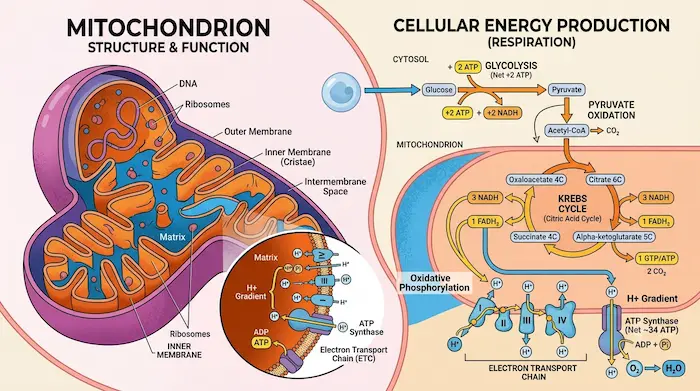
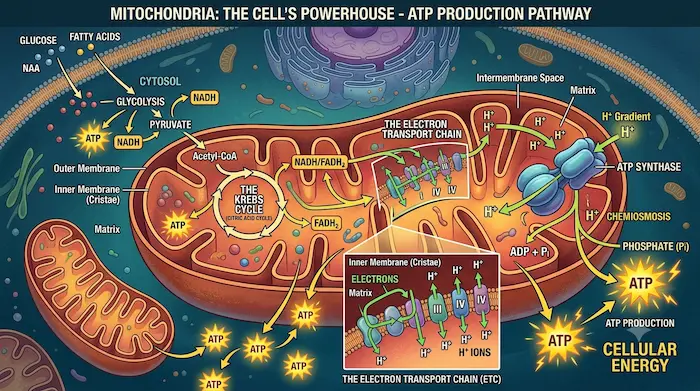
Think of mitochondria as rechargeable batteries inside every cell. They take in fuel and oxygen, then output ATP, the energy currency your body runs on. This process, called cellular respiration, happens inside a folded inner membrane unique to mitochondria. Generally speaking, the more folds a cell's mitochondria have, the more energy-producing capacity that cell carries. This energy production in cells is fundamental to all life. Mitochondria are responsible for mitochondrial energy production, converting nutrients into ATP to power cellular healing and repair.
Muscles, nerves, and brain tissue all depend heavily on mitochondria. So do heart tissue and skin, since both require a steady, reliable supply of energy to function and repair themselves. Tissues with the highest energy demands, such as muscle and heart tissue, tend to contain especially large numbers of mitochondria. That difference reflects how central cell metabolism and oxygen utilization are to a tissue's overall workload.
How Mitochondrial Function Supports Cellular Energy and Healing
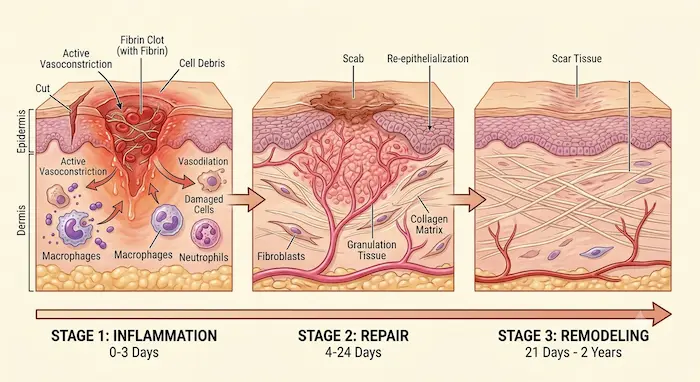
The body moves through a fairly predictable sequence after an injury: inflammation, immune response, repair and remodeling. Each stage asks cells to do more work than usual, which means each stage asks mitochondria to produce more ATP than usual. This is why mitochondrial function and recovery are so closely linked.
During the inflammation stage, immune cells rush to the injury site and rely heavily on energy to coordinate that response. As the body shifts into repair, cells need even more ATP to rebuild tissue, produce new proteins and manage the remodeling that follows. This is why mitochondrial support is connected to healing outcomes—when ATP supply cannot keep up with demand, healing tends to slow down. Patients in this state often notice more inflammation, more fatigue and slower tissue repair than expected.
Healthy vs. Unhealthy Mitochondria
| Healthy Mitochondria | Unhealthy Mitochondria |
|---|---|
| Efficient ATP production | Reduced ATP |
| Faster recovery | Slower healing |
| Better muscle recovery | Increased fatigue |
| Reduced oxidative stress | More oxidative stress |
Signs Your Cells May Not Be Producing Energy Efficiently
None of the signs below confirm mitochondrial dysfunction on their own. They are simply patterns worth paying attention to, especially when several appear together over an extended period. Many of these symptoms overlap with common, everyday causes such as poor sleep or a demanding schedule. That overlap is exactly why these signs should be treated as possible contributors rather than a diagnosis.
- Persistent fatigue
- Slow injury recovery
- Brain fog
- Chronic discomfort
- Muscle weakness
- Poor endurance
- Frequent inflammation
- Sleep issues
What Can Damage Mitochondria?
Mitochondrial health naturally declines with age, but lifestyle factors can accelerate that decline well before older age. The good news is that many of these factors are within a person's control. Oxidative stress deserves particular attention, since it can damage mitochondrial components directly. Chronic conditions such as diabetes and ongoing inflammation tend to compound this effect over time.
- Aging
- Poor diet
- Oxidative stress
- Lack of sleep
- Chronic stress
- Smoking
- Diabetes
- Ongoing inflammation
- A sedentary lifestyle
- Environmental toxins
How to Support Healthy Mitochondria Naturally
None of these habits work in isolation. Most patients see the best results when several of them are addressed together rather than picking just one. Exercise deserves special mention, since regular movement encourages the body to produce more mitochondria over time, a process known as mitochondrial biogenesis. This is key for muscle recovery and overall cellular regeneration. Sleep is equally important, since much of the body's cellular repair work, including DNA repair, happens during deep sleep.
- Balanced nutrition, with adequate protein intake
- Regular exercise
- Quality sleep
- Stress management
- Omega-3 fatty acids
- Antioxidant-rich foods
- Consistent hydration
- Sensible sunlight exposure
- Avoiding smoking
- Stable blood sugar management
The Connection Between Red Light Therapy and Mitochondria
Because mitochondria play a central role in ATP production, researchers have explored whether therapies such as red light therapy for mitochondrial health may influence cellular energy pathways involved in recovery. Research on red light therapy for mitochondrial health has explored how near-infrared wavelengths interact with mitochondrial activity. The proposed mechanism centers on an enzyme in the mitochondria called cytochrome c oxidase. Red and near-infrared light appear to interact with this enzyme in a way that may support the electron transport chain, the process mitochondria use to generate ATP. This remains an area of active research, but it is one reason light-based therapies are increasingly studied for recovery-related applications, with near infrared light therapy mitochondria being a key area of focus.
In practice, sessions typically involve exposing the treatment area to red or near-infrared light for a short period. The experience itself is generally comfortable, and no downtime is required afterward. Potential benefits that have been studied in connection with this mechanism include improved recovery, better blood circulation, and reduced muscle soreness. Additional areas of interest include joint discomfort, inflammation, and skin healing.
While mitochondrial function is only one factor involved in recovery, red light therapy is being studied as a non-invasive approach that may support cellular activity related to energy production and tissue recovery. Results vary from person to person, and outcomes depend heavily on the underlying condition being addressed. To learn more about how this therapy is applied and its potential benefits for cellular recovery, explore our Red Light Therapy service page.
Conditions Where Healthy Cellular Energy May Support Recovery
Nearly every tissue in the body depends on ATP. Conditions involving inflammation, nerve function, or tissue repair may all be influenced by how efficiently cells produce energy. This does not mean cellular energy is the sole factor behind any of these conditions. It simply means that supporting the body's energy production in cells may be a reasonable, complementary piece of a broader recovery plan.
- Sports injuries
- Arthritis
- Back pain
- Neuropathy
- Muscle strains
- Neck pain
- Joint pain
- Post-surgical recovery
- Chronic inflammation
Many of these conditions are also addressed through other approaches, including chiropractic care for spinal alignment and spinal decompression for nerve pressure. Supporting mitochondrial health is best viewed as one piece of a broader recovery picture rather than a stand-alone treatment.
Why Healing Takes Time
Healing is not an instant process. It requires a tremendous amount of cellular energy to rebuild damaged tissues, clear debris, and restore function. This is why mitochondrial health and healing are so closely linked. The body must prioritize energy production to fuel the repair process, which is why you often feel fatigued during recovery.
Several factors influence the speed of healing:
- Age: Mitochondrial efficiency naturally declines with age, slowing cellular regeneration.
- Inflammation: Chronic inflammation can impair mitochondrial function and delay repair.
- Circulation: Good blood circulation delivers oxygen and nutrients needed for ATP production.
- Sleep: Deep sleep is when much of the body's cellular repair and DNA repair occurs.
- Nutrition: A diet lacking in key nutrients can starve mitochondria of the building blocks they need.
Understanding these factors is crucial. Supporting mitochondrial health through lifestyle choices can help your body heal more efficiently, but it's also important to be patient and allow the natural healing process to unfold.
When to Seek Professional Care
If an injury or condition is not improving as expected, it is worth having it evaluated rather than waiting. A proper evaluation can identify whether structural issues, nerve involvement or another underlying factor is slowing recovery. Lifestyle habits that support mitochondrial health are valuable, but they work on a different timescale than clinical evaluation and treatment. Relying on lifestyle changes alone when symptoms are persistent or worsening can delay identifying a more specific, treatable cause.
At Absolute Integrative Physical Medicine, care for these concerns may include regenerative medicine for tissue healing support or shockwave therapy for chronic soft tissue issues, depending on what an evaluation finds.
- Persistent pain
- Injuries that are not improving
- Neuropathy symptoms
- Limited mobility
- Recovery taking longer than expected
Ready to support your body's natural healing process?
Our team can help you understand the root cause of your symptoms and build a comprehensive care plan, including red light therapy for cellular health and other evidence-based approaches.
Explore Our Red Light Therapy →Frequently Asked Questions
People Also Ask
- Can damaged mitochondria repair themselves? Yes, through a process called mitochondrial biogenesis, cells can create new mitochondria and repair damaged ones, especially with exercise and proper nutrition.
- What foods improve mitochondria? Foods rich in antioxidants, omega-3s, and CoQ10 support mitochondrial health, including berries, fatty fish, nuts, seeds, and leafy greens.
- Does fasting improve mitochondria? Some research suggests intermittent fasting may stimulate mitochondrial biogenesis and improve mitochondrial function.
- Can exercise create new mitochondria? Yes, regular aerobic and resistance exercise stimulate the production of new mitochondria, improving cellular energy capacity.
- Why do athletes have more mitochondria? Consistent training stimulates mitochondrial biogenesis, giving athletes more mitochondria for greater energy production in cells and endurance.
- Can poor sleep damage mitochondria? Yes, chronic poor sleep increases oxidative stress and may impair mitochondrial function and repair.
- What causes poor mitochondrial function? Factors include aging, poor diet, lack of exercise, chronic stress, environmental toxins, and oxidative stress.
References
Authoritative Sources
1. National Institutes of Health. (2023). Mitochondria: Structure and Function. https://www.ncbi.nlm.nih.gov/books/NBK26894/
2. Harvard Medical School. (2023). How to boost your mitochondria for better health. https://www.health.harvard.edu/blog/how-to-boost-your-mitochondria-for-better-health-202306192954
3. Cleveland Clinic. (2024). Mitochondrial Dysfunction. https://my.clevelandclinic.org/health/diseases/24878-mitochondrial-dysfunction
4. Mayo Clinic. (2024). Red Light Therapy: Does it work for pain?. https://www.mayoclinic.org/healthy-lifestyle/consumer-health/expert-answers/red-light-therapy/faq-20458247
5. National Institutes of Health. (2024). Mitochondria and Aging. https://www.nia.nih.gov/news/mitochondria-and-aging
Final Thoughts
Healing begins much deeper than muscles or joints. Every repair process starts inside your cells, where mitochondria generate the energy needed for recovery. Mitochondrial health is not just a buzzword—it's a fundamental biological process that determines how effectively your body can bounce back from injury, surgery, or illness. By understanding the connection between mitochondrial function and recovery, you can make more informed choices about your health.
Supporting mitochondrial health through healthy lifestyle habits, and evidence-based therapies such as our Red Light Therapy, may help create the conditions your body needs to heal more efficiently. If your recovery is taking longer than expected, our team in Vacaville can help you understand what may be behind it and develop a comprehensive plan to support your journey back to health.
Remember, cellular healing is the foundation of all recovery. By prioritizing your mitochondrial health, you are investing in your body's natural ability to repair and maintain healthy function.
This content is for informational purposes only and is not a substitute for professional medical advice, diagnosis, or treatment.