Reviewed by: Dr. Alex Tam, DC
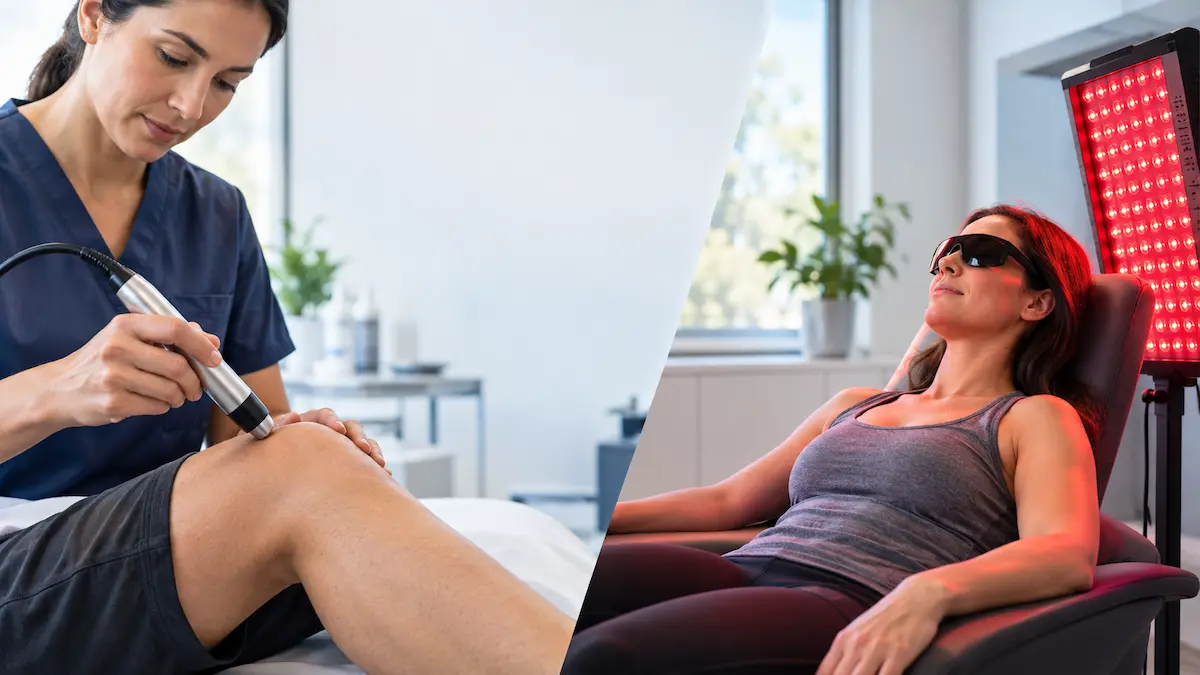
Cold laser therapy and red light therapy are related treatments that use light to influence biological activity, but they are not identical. Cold laser therapy uses low-intensity laser light, while red light therapy commonly uses light-emitting diodes (LEDs). Both can fall under photobiomodulation (PBM). Their effects depend on the wavelength, delivered dose, treatment area, device, and condition being treated. Neither method is universally better, and findings from laser-based studies cannot automatically be applied to LED devices.
Is Cold Laser Therapy the Same as Red Light Therapy?
No. Cold laser therapy, also called low-level laser therapy (LLLT), uses laser light, while red light therapy commonly uses LEDs. Both can be forms of photobiomodulation, and both may use red or near-infrared wavelengths. The distinction matters because light source, treatment parameters, and clinical evidence can differ.
Three terms help clarify the difference:
- Cold laser therapy: A treatment using low-intensity laser light directed at a specific area. The term “cold” distinguishes it from treatments intended to heat or destroy tissue; it does not mean the treatment uses cold temperatures.
- LED red light therapy: A treatment using light-emitting diodes. Depending on the device, it may target a small area or cover a larger part of the body.
- Photobiomodulation (PBM): An umbrella term for the use of non-thermal light to influence biological processes. It includes both laser-based and LED-based approaches.
These terms overlap, but they are not interchangeable descriptions of every device or treatment protocol.
How Do Cold Lasers and Red Light Therapy Differ?
The main differences involve how the light is generated, how it is delivered, the area treated, and the parameters used to determine dosage. Wavelengths can overlap between the two technologies, so the device label alone does not establish which treatment is appropriate.
Does a Laser Work Differently From an LED?
Yes, in terms of light characteristics. Laser light is generally more collimated, meaning its rays travel in a narrower, more parallel direction, and more coherent, meaning the light waves have a more organized phase relationship. LED light generally spreads over a wider angle and is less coherent.
These physical differences do not automatically make a laser more effective. A perspective review by Heiskanen and Hamblin discussed the differences between lasers and LEDs in photobiomodulation and the limitations of direct comparisons. Clinical outcomes depend on the specific device, treatment parameters, and condition being investigated.
In practice, many cold laser devices are used on localized areas or a series of treatment points. LED panels can cover broader areas, including the full body, depending on the equipment.
Do Both Treatments Use Red and Near-Infrared Wavelengths?
Yes. Both laser and LED devices may emit red or near-infrared light, although the wavelengths available depend on the specific device.
Red light used in photobiomodulation commonly falls within approximately 600–700 nanometers (nm). Near-infrared devices often use wavelengths around 780–1,100 nm, although device specifications vary.
Near-infrared light generally penetrates tissue differently from visible red light. However, tissue penetration is affected by wavelength, absorption and scattering, the tissue being treated, and the device's delivery characteristics. A laser is not automatically deeper-reaching than an LED solely because it is a laser.
To understand a particular treatment, check the device's actual wavelength specifications rather than relying on terms such as “cold laser,” “infrared,” or “red light” alone.
Does Treatment Dose Matter More Than the Device Label?
The device label alone is not enough to determine how a treatment will perform. The wavelength, power delivered to the treatment area, exposure time, treatment area, and protocol all affect the dose.
Important terms include:
- Wavelength: The wavelength of the emitted light, measured in nanometers.
- Irradiance: The optical power delivered per unit area, commonly expressed in milliwatts per square centimeter (mW/cm²).
- Fluence: The energy delivered per unit area, commonly expressed in joules per square centimeter (J/cm²).
- Exposure time: How long the light is applied.
- Treatment frequency: How often sessions occur and how many are included in a course of treatment.
Photobiomodulation may have a biphasic dose response, meaning that increasing the dose does not necessarily increase the benefit. The optimal parameters depend on the application, and a protocol developed for one device should not automatically be transferred to another.
A 2019 systematic review and meta-analysis by Stausholm and colleagues examined 22 randomized placebo-controlled trials involving 1,063 participants with knee osteoarthritis. Low-level laser therapy was associated with a 14.23 mm reduction in pain on a 100 mm visual analogue scale at the end of treatment compared with placebo. In a subgroup of trials using doses recommended by the World Association for Photobiomodulation Therapy, the reduction was 18.71 mm. These results concern the laser protocols studied; they do not establish equivalent results for LED devices.
Cold Laser vs. LED Red Light Therapy: Technology Comparison
| Comparison factor | Cold laser therapy | LED red light therapy |
|---|---|---|
| Light source | Laser diode or another laser source | Light-emitting diodes |
| Light characteristics | Generally more collimated and coherent | Generally less collimated and less coherent |
| Wavelengths | Device-specific red and/or near-infrared wavelengths | Device-specific red and/or near-infrared wavelengths |
| Treatment area | Often localized or point-by-point | Localized or broader-area coverage, depending on the device |
| Dose | Depends on output, treatment spot, exposure time, and protocol | Depends on irradiance, distance, treatment area, exposure time, and protocol |
| Typical delivery | Often applied to specific treatment sites | May use handheld devices, panels, or larger systems |
| Evidence limitations | Findings depend on the studied device, condition, and protocol | Findings depend on the studied device, condition, and protocol |
| Interchangeability | Not automatically interchangeable with LED treatment | Not automatically interchangeable with laser treatment |
Which Works Better for Pain, Inflammation, or Tissue Recovery?
Current evidence does not establish that cold laser therapy or LED red light therapy is universally more effective. The strength of the evidence varies by condition, and results from different studies cannot reliably establish which modality is better when the devices, doses, patient populations, and outcomes differ.
Which Is Better for Acute Musculoskeletal Pain?
Neither treatment has been established as superior across acute musculoskeletal conditions.
A 2009 systematic review and meta-analysis by Chow and colleagues examined low-level laser therapy for neck pain. It included 16 randomized trials involving 820 patients. The analysis reported a benefit for acute neck pain compared with placebo, but that specific finding was based on only two trials. The results should not be generalized to every acute injury or to LED devices.
For LED therapy, a 2018 randomized placebo-controlled trial by Prianti and colleagues investigated 627 nm LED phototherapy in 40 people with grade II ankle sprains. Participants also received standard first-aid care. The study reported improvements in pain and swelling in the LED group compared with placebo.
These studies examined different conditions and treatment protocols. They do not provide a direct comparison of laser and LED treatment for the same injury.
Which Is Better for Chronic Joint Pain, Such as Knee Osteoarthritis?
Low-level laser therapy has been studied in randomized trials for knee osteoarthritis, but findings should be interpreted in the context of study quality and treatment parameters.
The 2019 meta-analysis by Stausholm and colleagues reported a 14.23 mm reduction in pain on a 100 mm scale across the included trials at the end of treatment. In the subgroup using recommended doses, the reduction was 18.71 mm.
A separate 2024 systematic review by Oliveira and colleagues reported a standardized mean difference of −0.7 for pain at rest, with a 95% confidence interval from −1.1 to −0.2. The authors rated the certainty of the evidence as very low and did not find a significant effect on the Timed Up and Go (TUG) functional test.
The results of these reviews should not be compared as if they used the same measurement scale or methods. They also do not establish that laser therapy is superior to LED treatment because the available evidence does not provide a robust, direct comparison of the two modalities for knee osteoarthritis.
For condition-specific information, see our page on knee arthritis care in Vacaville.
Do Cold Laser and Red Light Therapy Reduce Inflammation Equally?
The available evidence does not establish that the two modalities reduce inflammation equally.
Researchers may measure inflammation through laboratory biomarkers, tissue changes, pain scores, swelling, or functional outcomes. These measures are related but not interchangeable. A change in a biomarker does not necessarily mean that a patient experiences meaningful symptom relief or improved function.
A small 2009 study by Leal-Junior and colleagues compared a multi-diode LED cluster with a single-diode laser in eight healthy athletes. The study examined creatine kinase, a marker associated with muscle damage. Because the devices differed in wavelength and output, the results cannot isolate the effect of the light source alone.
Further condition-specific research is needed before drawing broad conclusions about the comparative effects of laser and LED therapy on inflammation.
What About Skin, Wound, and Tendon Recovery?
Evidence for skin, wound, and tendon outcomes must be evaluated separately because the biological processes and clinical goals differ.
A 2007 study by Lee and colleagues investigated LED phototherapy using 633 nm and 830 nm light for skin rejuvenation in 76 participants. It reported improvements in cosmetic measures such as wrinkles and skin elasticity. These findings concern cosmetic skin outcomes and do not demonstrate that the same treatment improves musculoskeletal pain or tendon healing.
A 2026 systematic review by Miranda and colleagues compared laser and LED photobiomodulation in 16 experimental studies of cutaneous wound healing. The review described biological effects involving processes related to tissue repair but emphasized substantial heterogeneity in experimental parameters. Because the included evidence was experimental and preclinical, the findings cannot establish equivalent clinical wound-healing outcomes in humans.
Evidence for Achilles tendinopathy is also limited. A 2020 systematic review and meta-analysis by Cabrera Martimbianco and colleagues included four trials involving 119 participants. The review found that the evidence was of very low to low certainty and insufficient to support routine use of low-level laser therapy for Achilles tendinopathy.
These findings illustrate why results for one application should not be treated as proof of benefit for another. Cosmetic skin changes, laboratory markers, wound-healing outcomes, pain reduction, and restored function are different endpoints.
What Does Research Say About Low Back Pain?
Research on photobiomodulation for low back pain does not establish that cold laser or LED treatment is an effective option for every patient.
A 2020 systematic review by Tomazoni and colleagues examined photobiomodulation for nonspecific low back pain. A 2021 placebo-controlled trial by Guimarães and colleagues also investigated photobiomodulation for chronic low back pain. These sources should be interpreted according to the devices and protocols studied rather than generalized to all laser and LED systems.
Because some low-back-pain research groups different photobiomodulation devices together, it may not be possible to isolate the effectiveness of laser treatment from LED treatment. Patients should not assume that findings for one device apply to another without supporting evidence.
Condition-Specific Evidence Comparison
| Condition or outcome | Evidence reviewed | What can reasonably be concluded |
|---|---|---|
| Neck pain | Laser meta-analysis involving 16 trials and 820 patients | A benefit was reported, but the acute-pain finding was based on two trials |
| Knee osteoarthritis | Laser meta-analysis and a separate systematic review | Some pain outcomes improved, but certainty and functional findings vary |
| Grade II ankle sprain | One LED randomized trial involving 40 participants | A small study reported improvements in pain and swelling |
| Low back pain | Systematic review and placebo-controlled trial of photobiomodulation | Findings depend on the studied protocol; results should not be generalized to all devices |
| Achilles tendinopathy | Review of four laser trials involving 119 participants | Evidence was insufficient to support routine use |
| Cosmetic skin outcomes | LED study involving 76 participants | Findings apply to the cosmetic outcomes investigated |
| Experimental wound healing | Review of 16 preclinical studies | Findings are not proof of equivalent human wound-healing outcomes |
Do Cold Laser and Red Light Therapy Use Different Treatment Schedules?
Often, yes. Treatment schedules vary according to the device, wavelength, delivered dose, treatment area, and condition being investigated. There is no established universal schedule that applies to all cold laser and LED treatments.
Clinical studies use different treatment courses and follow-up periods. For example, the LED ankle-sprain trial by Prianti and colleagues used a short treatment course, while knee osteoarthritis trials included different laser protocols and outcome-measurement points.
| Research example | Treatment information | Important limitation |
|---|---|---|
| LED therapy for grade II ankle sprain | The study investigated a short treatment course in 40 participants | The schedule cannot be generalized to other conditions or devices |
| Laser therapy for knee osteoarthritis | Trials used varying wavelengths, doses, and session protocols | The results apply to the protocols investigated |
| Laser therapy for Achilles tendinopathy | Four trials were included in the systematic review | The evidence was low certainty and insufficient to support routine use |
A treatment schedule from one laser study may not apply to an LED panel or full-body system. Ask which protocol has been studied for your condition and how progress will be measured.
Are Cold Laser and Red Light Therapy Equally Safe?
Neither therapy should be described as universally risk-free. Safety depends on the device, treatment settings, treatment location, and individual medical history.
Important considerations include:
- Eye protection: Follow the manufacturer's eye-safety instructions. Laser and high-intensity LED devices may have different requirements depending on their specifications.
- Photosensitivity and medications: Some medications and medical conditions can increase sensitivity to light. Tell your clinician about medications and relevant health conditions before treatment.
- Medical history: Pregnancy, implanted electronic devices, known or suspected tumors in the treatment area, active bleeding, and serious heart or kidney conditions may require additional evaluation depending on the device and circumstances. These should not automatically be treated as universal contraindications for every photobiomodulation device.
- Treatment location: The location being treated matters. For example, treatment near an implanted device or over the abdomen during pregnancy raises different considerations from treatment of a knee.
- Device-specific instructions: Follow the device's labeling and instructions regarding wavelength, treatment distance, exposure time, protective equipment, and treatment area.
- Professional evaluation: A qualified clinician can review your medical history, the proposed device, and the reason for treatment before recommending a protocol.
Regulatory status also requires careful interpretation. In the United States, FDA 510(k) clearance means a device has been found substantially equivalent to a legally marketed predicate device for its intended use. It should not be interpreted as proof that the device is effective for every condition or that all devices using similar light sources have the same clinical evidence.
The FDA provides an overview of the 510(k) process and a 510(k) database for checking specific devices.
How Do You Know Which Light Therapy Is Appropriate for Your Condition?
The appropriate treatment depends on your diagnosis, goals, medical history, and the evidence for the particular device. The label alone cannot determine whether a treatment is suitable.
Before starting treatment, consider asking:
- What condition is being treated, and what evidence supports using this modality for that condition?
- Which wavelength, dose, and session schedule were used in the relevant studies?
- Is the device comparable to the one used in the research?
- Could any medications or medical conditions affect safety?
- How will progress be measured, and when should the treatment plan be reassessed?
- What other treatment options may be appropriate?
For information about the clinic's LED-based approach, see our page on full-body red light therapy. You can also read our overview of what research says about cold laser therapy.
Frequently Asked Questions
This content has been reviewed by our healthcare professionals for accuracy and educational purposes. It should not be used as a substitute for professional medical advice, diagnosis, or treatment.