Sharp Lower Back Pain When Bending - What It Means
That sudden, sharp pain when you bend down to pick something up is hard to ignore. It stops you mid-movement, forces you to straighten up slowly, and leaves you wondering whether something is seriously wrong.
Sharp lower back pain when bending is one of the most common complaints seen in spinal care - and one of the most misunderstood. Many patients assume it is just a pulled muscle and wait for it to pass. But when bending consistently triggers sharp or intense pain, it is usually a sign that something mechanical is under stress. Identifying the cause early is what separates a fast recovery from a problem that compounds over months.
Unlike general soreness, sharp pain during movement often points to a mechanical or structural issue.
Table of Contents
- Why Bending Forward Triggers Sharp Lower Back Pain
- What Causes Sharp Lower Back Pain When Bending?
- Symptoms That Frequently Accompany Bending Pain
- How to Tell If It’s More Than a Simple Muscle Strain
- Why Sharp Bending Pain Should Not Be Ignored
- How Sharp Lower Back Pain When Bending Affects Daily Life
- When Should You Seek Evaluation?
- Non-Surgical Treatment Options for Sharp Lower Back Pain in Vacaville
- When to Schedule an Evaluation for Lower Back Pain in Vacaville
- Frequently Asked Questions About Sharp Lower Back Pain When Bending
Why Bending Forward Triggers Sharp Lower Back Pain
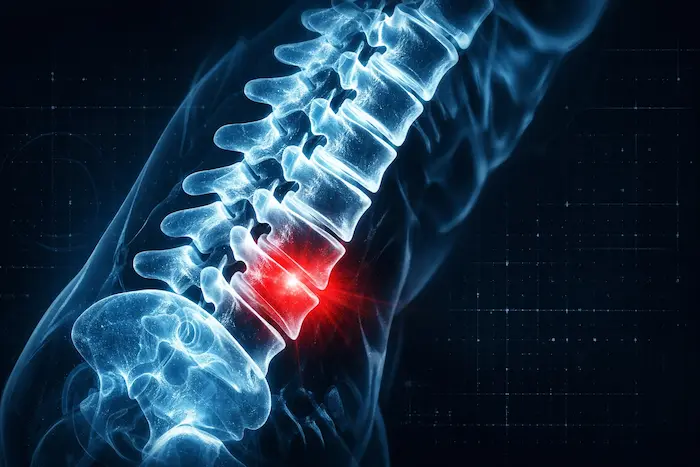
Bending is not a simple movement. It places significant mechanical demand on the spine, the discs between the vertebrae, and the surrounding soft tissue all at once.
When you bend forward, the front portion of each spinal disc compresses while the back portion stretches outward. If a disc is already weakened or damaged, that shift in pressure can trigger immediate, sharp pain. The muscles and ligaments of the lower back are also being lengthened under load during this movement - and if they are strained or inflamed, the result is often a sudden, stabbing sensation.
This is why many patients feel perfectly fine while standing or sitting still, yet experience intense discomfort the moment they lean forward.
What Causes Sharp Lower Back Pain When Bending?
Sharp bending pain is not a diagnosis - it is a symptom. Several different structural problems can produce it, and the treatment approach depends entirely on which one is responsible.
Muscle Strain
Muscle strain is the most common starting point. It typically results from lifting with poor mechanics, a sudden awkward movement, or repetitive overuse over time. The pain is usually localized - meaning it stays in one area without radiating - and it may ease with rest in the short term.
The concern with recurring muscle strain is that repeated episodes signal an underlying stability problem. If the muscles of the lower back are regularly overloaded, the spine itself begins to compensate in ways that accelerate wear on the discs and joints.
Herniated or Bulging Disc
The discs between the vertebrae act as shock absorbers. When a disc is damaged - either through gradual degeneration or sudden trauma - its outer layer can bulge or tear. Bending forward increases the pressure inside the disc and often intensifies pain directly.
If the damaged disc is pressing on a nearby nerve root, bending may also trigger radiating symptoms - pain, tingling, or numbness that travels from the lower back into the hip, buttock, or leg. This combination of local and radiating pain is a strong indicator of disc involvement. Review herniated disc symptoms and warning signs →
Nerve Compression
When a nerve is compressed - whether from a disc, bone spur, or spinal narrowing - bending forward can increase that pressure acutely. The result is often a sharp, electric pain that may travel along the nerve path rather than staying in the lower back.
Common associated symptoms include tingling or numbness in the leg or foot, weakness in the leg, or pain that worsens when sitting and eases when walking. These patterns suggest the source is neurological, not purely muscular.
Explore spinal decompression therapy for nerve compression and disc pain → to learn how reducing spinal pressure can relieve these symptoms.
Spinal Joint Dysfunction
The facet joints connect the vertebrae and guide the range of spinal motion. When these joints become irritated, inflamed, or misaligned, bending - particularly forward or to the side - can produce sharp, localized pain that may extend into the buttocks.
Facet joint issues are often accompanied by stiffness that is worse in the morning or after prolonged sitting. The pain typically eases with gentle movement but flares sharply with certain positions.
Degenerative Changes in the Spine
Over time, the cumulative effect of daily use wears down spinal structures. Disc height decreases, joint surfaces roughen, and the spine becomes less capable of absorbing the mechanical stress of routine movements like bending.
Degenerative changes do not develop overnight, but they often become symptomatic gradually - starting with occasional sharp pain during movement before becoming more consistent.
Symptoms That Frequently Accompany Bending Pain
Sharp pain when bending rarely appears in isolation. Pay attention to the full picture of what you are experiencing, as it provides important diagnostic information.
These may include:
- stiffness in the lower back
- pain when returning to an upright position
- discomfort when sitting for long periods
- reduced flexibility
- muscle tightness
In cases involving nerve irritation, tingling, numbness, or pain traveling into one or both legs may also be present.
How to Tell If It’s More Than a Simple Muscle Strain
Muscle strains are common and typically improve within one to two weeks with rest and basic care. Certain signs, however, suggest the problem goes deeper.
You should be cautious if:
- pain persists beyond a few weeks
- symptoms worsen over time
- pain radiates into the leg
- numbness or tingling develops
- movement becomes increasingly limited
Seek evaluation if the pain has persisted beyond two to three weeks without improvement, if symptoms are worsening rather than gradually resolving, if pain radiates from the back into the hip or leg, or if tingling or numbness has developed in the lower extremities. Movement that is becoming progressively more limited - not just sore - is also a red flag worth investigating.
Why Sharp Bending Pain Should Not Be Ignored
Pain that appears specifically during movement is often an early structural warning. The spine is signaling that something is under more stress than it can comfortably manage.
Left unaddressed, the consequences tend to compound. Disc damage progresses. Nerve irritation increases. Muscles tighten chronically in a protective response that adds its own layer of dysfunction. What starts as a sharp but manageable pain during one movement can evolve into constant discomfort that affects how you sleep, work, and move through every part of your day.
If left untreated, potential risks include:
- progression of disc damage
- increased nerve irritation
- chronic back pain
- reduced mobility
Addressing the cause early - before compensation patterns set in - gives the spine the best chance at real recovery.
How Sharp Lower Back Pain When Bending Affects Daily Life
Bending is not a special movement. It is built into virtually every daily task - picking up a child, unloading the dishwasher, getting dressed, reaching into a lower drawer.
When bending becomes painful, people begin unconsciously modifying how they move. They bend their knees excessively, twist to one side, or avoid certain movements entirely. These adaptations place abnormal stress on the hips, knees, and upper back - creating secondary problems that compound the original issue over time.
Patients in Vacaville frequently seek care not just because of the back pain itself, but because of how dramatically it has begun limiting activity and independence.
When Should You Seek Evaluation?
You should consider evaluation if:
- sharp pain occurs frequently
- symptoms are worsening
- bending becomes difficult
- pain affects daily activities
- nerve symptoms are present
A proper assessment can identify whether the issue is muscular, disc-related, or nerve-related.
Non-Surgical Treatment Options for Sharp Lower Back Pain in Vacaville
Treatment should target the actual structural cause of pain - not just mask the symptom. And that is our main goal at Absolute Integrative Physical Medicine. Several effective non-surgical approaches address the root problem directly.
Spinal Decompression Therapy
Reduces pressure on compressed discs and nerve roots by gently creating space within the spine. For patients whose bending pain is caused by disc herniation or nerve compression, this treatment directly addresses the mechanical source of their symptoms. Learn more about spinal decompression therapy for lower back pain →
Chiropractic Care
Corrects spinal alignment and restores proper joint function. When facet joints are misaligned or restricted, specific adjustments improve movement mechanics and reduce the pain response triggered by bending. Explore chiropractic care for lower back pain in Vacaville →
Regenerative Medicine
Supports tissue repair at the source of damage - reducing inflammation in and around affected discs, joints, and nerve tissue. This is particularly valuable for patients whose pain has a degenerative component. Review regenerative therapy options for spinal pain →
Movement and Rehabilitation
Strengthens the muscles that stabilize and protect the spine - reducing the mechanical load on discs and joints during everyday movements like bending. Targeted rehabilitation also corrects the movement patterns that originally contributed to the problem, lowering the risk of recurrence significantly. Don't worry, we also help you with that.
When to Schedule an Evaluation for Lower Back Pain in Vacaville
If sharp lower back pain when bending is occurring frequently, worsening over time, or beginning to limit your daily activities, a comprehensive evaluation is the right next step. The sooner the cause is identified, the more options are available - and the more effective those options tend to be.
A proper assessment examines not just where you feel pain, but the structural and mechanical factors that are producing it. That understanding drives a targeted treatment plan rather than a generic one.
Schedule your lower back pain consultation →
Find out exactly what is causing your symptoms and which treatment approach is right for your condition at Absolute Integrative Physical Medicine.
Frequently Asked Questions About Sharp Lower Back Pain When Bending
Bending forward compresses the front of the spinal discs and stretches the muscles and ligaments of the lower back. If any of those structures are damaged, inflamed, or under excessive stress, that movement triggers sharp pain. The specific cause - whether disc, muscle, nerve, or joint - determines the appropriate treatment.
It can be. Sharp pain that is triggered consistently by bending - especially if it radiates into the leg or is accompanied by tingling or numbness - suggests disc involvement or nerve compression rather than simple muscle strain. Persistent symptoms deserve a professional evaluation.
Yes. Bending forward directly increases pressure inside the spinal discs. If a disc is herniated or bulging, that pressure intensifies pain at the disc level and may also aggravate any nearby nerve root that the disc is contacting.
Treatment depends on the underlying cause. Spinal decompression is highly effective for disc and nerve compression. Chiropractic care addresses joint dysfunction and alignment. Regenerative therapy supports tissue repair. The most effective outcomes come from identifying the source first - then matching the treatment to it.
If pain is persistent beyond two weeks, worsening rather than improving, radiating into the leg, or limiting your ability to perform normal daily activities, do not delay evaluation. Early care consistently produces better outcomes than waiting for symptoms to resolve on their own.
We are ready to help you – Schedule an Appointment Today
If you have been suffering from sharp lower back pain when bending, persistent stiffness, or signs of nerve irritation that may be affecting your overall health and wellness, don't wait any longer. For personalized treatment options and expert guidance, schedule a consultation with our team of specialists today!
Visit: 👉 https://absoluteintegrativehealth.com
Or contact Absolute Integrative Physical Medicine to schedule a comprehensive evaluation for your back pain and spinal health today.
Schedule an appointmentGive us a call today at (707) 474-5688 and secure your spot this month for an in‑depth evaluation. Stop pushing and ignoring symptoms and pain – let us take care of you so you can get back to enjoying your life!